Wednesday, February 01, 2012

February's Gypsy

My February Gypsy is born of the roots of the Earth traveling through the colors of the forests: the trees, the mosses, the leaves, the vines, the very mists and fogs that rise from these places each morning.

She has always had her many scarves, cloaks of textures and variations and as she dances, spins,  and jumps for joy.
They twirl about her, ever increasingly so, creating the slight curtain of mists allowing the titillated mind the travels of the gypsy caravan.
  

When the evenings are cold; however, she loves a warm and cozy bedroom.

The spreads and blankets remain warm and inviting while she takes the willing traveler on adventures to places of exotic colors, light, sounds and smells.

With roots planted in her home; the February Gypsy journeys, the vehicle her heart, the key her love of stories. Stories from books, fairy tales, nursery rhymes, the classics and current novels all add to the mystery of the February Gypsy's travel.


My February Gypsy appreciates a love for all things beautiful and exotic. She wraps herself warmly - as the weather dictates - in glad rags gathered from all her adventures, near and far. For her, much of her art is her dress. She adds some color to the world around her that the one time deciduous trees have lost, that the flowers once bloomed have now also lost. While the world sleeps in February, she wraps herself and her world in joyful, jewel-like colors.

Inside her home, her caravan wagon, my February Gypsy keeps colors alive in these days of February. She keeps small planters, hangs colorful bottles, dried fruit and strings of beads and colorful strips of fabric patches. In this month she works on furniture projects to call them to the gypsy heart.


bohemianbedding.info


Outside, too, the paintbrush will come out and add colorful flair to the greying world around her. She either puts flowers in pots, or throws a shawl on a table for a sunny afternoon tea. Either way, it's an adventure, a journey for the mind's eye each time viewed.


Throughout February, I hope to show in this blog the different adventures I go on as I play my Gypsy. I am already working on some now. I only have to remember to take the pictures - the hardest part sometimes!

Peace.
Brianne

Friday, January 27, 2012

Just an Old Dead Tree

The other day a pair of pileated woodpeckers came flying through the trees in the yard. They are always an awesome site; wide wing span and wobbly headed, their call precedes them.

For years they have come to the yard and what do they seek out? The dead wood in the trees. They eat any bugs that inhabit the branches and bark.

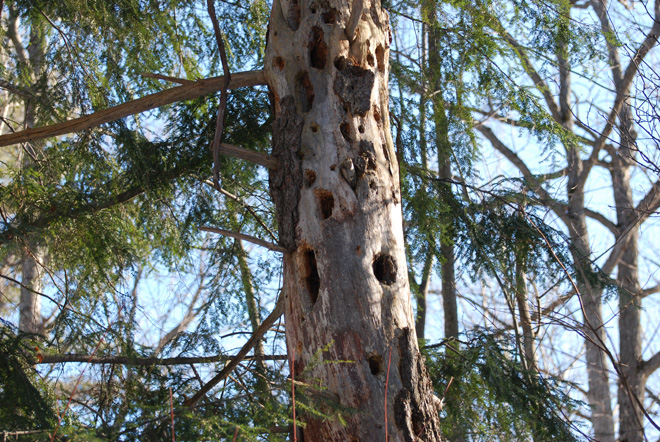
Tom and I have always left old dead trees, being careful to cut down to a point that part of any tree that could dangerously fall on the house or my beloved patio.  Hurricanes visiting every year or so has lead us to make that decision. We leave this botton part of the tree, or the dead tree itself if it isn't in a troublesome spot, for the very purpose of attracting the pileated woodpeckers and allowing housebuilding for other birds and mammals.

 In my little corner of the world, I can see the variety of life nesting within the confines of the old dead trees, like the Eastern Screech Owl and the Red Bellied Wood peckers, as well as the insects and the anoles (lizards).

On a greater scale, nearly a third of all forest creatures depend on trees at all various ages and stages of life for their survival. Healthy forests need to contain trees of all ages, even standing old dead trees. Even fish benefit from trees that have fallen into stream channels and use them as nurseries. I just read that wood ducks like to use cavities in old dead trees by water to raise their young. Sweet.


Old dead trees tend to have large branches break off and create an area that is called a snag. This snag is prime real estate for nest building.

Actually, when a nesting pair chooses their home snag, they come back year after year after year to raise young. This is true for the American Bald Eagle, the Great Horned Owl (who actually likes to move into a preowned model); and Coopers Hawks.

Also, snags are loved by mammals, like raccoons and bats (especially if their are cavities adjacent). 


Black bear coming out of hibernation.


Holes are made in the trunks of old dead trees over time or are easily made, the animals who love these are the cottontail rabbit, red fox, striped skunk, and if you live in an area with the habitat, the Black Bear.

 
Actually, on a hike one time in the Appalachian Mountains, I saw a Black Bear in a tree cavity. I didn't know for certain until I got home and read that this is indeed a hibernation home, an old dead tree, for the Black Bear.


The pictures below are of old dead trees protected by individuals, societies, or communities that have realized that the from death comes life.

Some are just taken by the photographer because of the awesome beauty and untold story of an old dead tree.


I am always reminded of this pattern in life: from death comes life, when I come across the growth of resurrection fern on the rotting log of an old dead tree. The fern was named because of the very notion that from death comes life.


Oh, yes, I didn't even go over all the plant life, flora, that loves an old dead tree. But, that my friends, is another story....


conservewildlifenj.org


hitomii.deviantart.com


To everyone all over the word PLEASE leave your dead trees standing!
forestpolicy.posterous.com

 
corazondedios.deviantart.com

  
These last two pictures are of the two trees, old dead trees, that are existing in the yard at this time. Slowly, they are contributing to the future of so many tomorrows. 


I hope in some way, the beauty you have seen in the old dead trees, and the realization of the life they actually cradle, will open your heart to allow one to " do their thing," slowly in your yard next time it dies. Maybe you could just leave just a little, cutting only the top part that could be a potential harm to your home or structures.  If you do, you'll be amazed at the life you'll be able to witness. Get your camera ready!!

Peace.
Brianne

Tuesday, January 17, 2012

Two Seasons in Florida

When the Season passes to this one: No Mosquito Season in Florida, my mind wonders to living in the Tree House.

The cool breeze of the North Florida woods lightly lifts the ivy from the window sills as I mix the granola.

Masala has to be lifted by a levy these days; his arthritis prevents him from making it up the stairs.

Like always, we backpack the cats up. There are just two these days.

The parrot, Emmett, comes up in his little "travel cage."

Tom and I, with cracking knees, hardly make it up without injury.


But, when we settle in, warm blankets all about, the futon bed we carried up years ago in the corner; we read (our e-readers replacing our bags of paperbacks from days past) and drink our chai or coffee in front of the little wood stove.

We can bathe in the light of the waning moon as it shines through the panes of glass above. Later, the stars, in the darkened sky, are like a magical show above.


Tonight, the temperature won't drop to freezing, so I'll be able to enjoy the lullaby of the forest: the pines as they dance in the starlight, the critters as they charm the forest beneath me, without the chattering of my teeth vanquishing all other sounds.


Our breathing and night sounds will, these nights, be a part of the forest; while we breathe in the exhaled oxygen of the trees, they will breathe in our exhaled carbon dioxide. We will sleep in symbiotic relationship.


As a treat for all who would love such a scenario, as would I, the following photographs are chosen for your delight.


Enjoy your daydreams about treedreams.

Peace.
Brianne


All these pictures I was so fortunate to find on Pinterest. However, over the pins, the original photographer credits were lost on each. They are not mine. I give honor to whoever had the glorious adventure and the beutiful eye to share these with others.

Friday, January 13, 2012

Eating Seasonally

In addition to Reusing and Recycling, I also try to choose produce that is organic and In Season. Florida may not have "the Seasons" that bring crisp bright leaves falling from the trees and sweaters and then coats out of the closets at regular intervals every year; but by eating Seasonal produce, I can make my life feel that annual change as well as keep the impact of the cost of my foods resource to get to my table at a minimum.

Winter, obviously, is the most challenging in choosing fresh, locally grown produce.

We can't - of course - have a ready knowledge of our community's larder and what has been stored since the local harvest to help sustain us through the Winter or what has just recently been shipped over from Central Africa to reach the produce bin at Publix. So although the stores my have bountiful supplies of strawberries and grapes and bananas; it is not what is in my hemisphere's growth pattern.

Because, I want to pick my food choices by what is seasonal and regional, and because it is Winter, I am limited right now on having many produce choices. I tend to make breads the most in Winter. I also cook grains and add nuts and seeds to dishes in the Winter more often than at other times of the year.

This is not at all suffering, not picking whatever is on the shelves of the big grocery shelves. I find it exciting to live within the seasons. In the heat of Summer, I sometimes find myself thinking, longfully, of the day, in Winter, when I will be preparing and eating a nice warm barley soup with a big hunk of homemade rye bread; something as I sit down to my cool Summer salads, I wouldn't have on the table. Just last week I had that nice bowl of barley soup with fresh rye bread!

I put together a list for Winter in-season produce in North America (below). I keep a list on my refrigerator. It makes meal planning and grocery shopping according to each Season relatively easy.

North America Winter Produce Remember, you can enjoy the taste of any fruit or vegetable year-round. Fresh, frozen, canned, dried, and 100% juice – it all counts! But, try organic as much as possible.


Apples (Southeastern Region)

Brussels Sprouts (Southeastern Region)

Buttercup Squash

Cactus Pear

Collard Greens (Southeastern Region)

Clementines

Chestnuts


Delicata Squash

Grapefruit (Southeastern Region)

Kale (Southeastern Region)

Kiwifruit

Leeks (Southeastern Region)


Oranges (Southeastern Region)

Passion Fruit


Spinach (Southeastern Region)

Sweet Dumpling Squash (Southeastern Region)

Sweet Potatoes (Southeastern Region)

Tangerines (Southeastern Region)

Turnips (Southeastern Region)

Winter Squashes

 Just yesterday I made a potato and leek pie. I think that the leek is my favorite Winter vegetable. Tom loves the winter squashes and I can cook them probably one hundered ways as well as prepare them "raw" another 25; but I like the leek!

What is your favorite Winter produce? How do you like to prepare your cooking and baking to the Seasons?

Joyful Kitchen Dancing!
Peace.
Brianne

Saturday, January 07, 2012

Mini Album

I like this little mini album because it is a way of recycling not just on the book, but by reusing many materials and having fun.

I should have shown the steps from the start; however, they are not difficult to visualize.

1. Scavenge: The album usually originates as a child's tiny cardboard book, or it could possibly be one of those little adult inspirational books. The ones that are for children are often of the Christian faith and found in the children's section. They are best to find used because of the cost, so have a nice hunt at the second hand book stores or book stalls at the fleas. For the mini albums, I keep a box for little pieces of ribbon, paper, buttons, sticks, tags from clothing and food items, and other interesting items that I think I would be able to use again and add to it as I find things "fun and functional."


2. Prepare Surface: Once you have the book, lightly sandpaper the pages. Then give them a once over with white gesso. After that you can paint, seal, paper or do whatever turns you on. There are endless possibilities and the tags and additions are all recycled papers and tags from different projects and "stuff." You can treat these just like any mini album  and You tube gives you an endless array of ideas for decorating in short videos. I have only done three and have two more books left. I even have one book that has cut out "windows" throughout.

3. Have Fun: I put this one together for my Mother's nurse. My Mom wanted to give her something "Japanese" because she had just adopted a little girl from Japan.  I tried to incorporate Japanese oldschool and newschool prints as well as "young" happy book about new life.


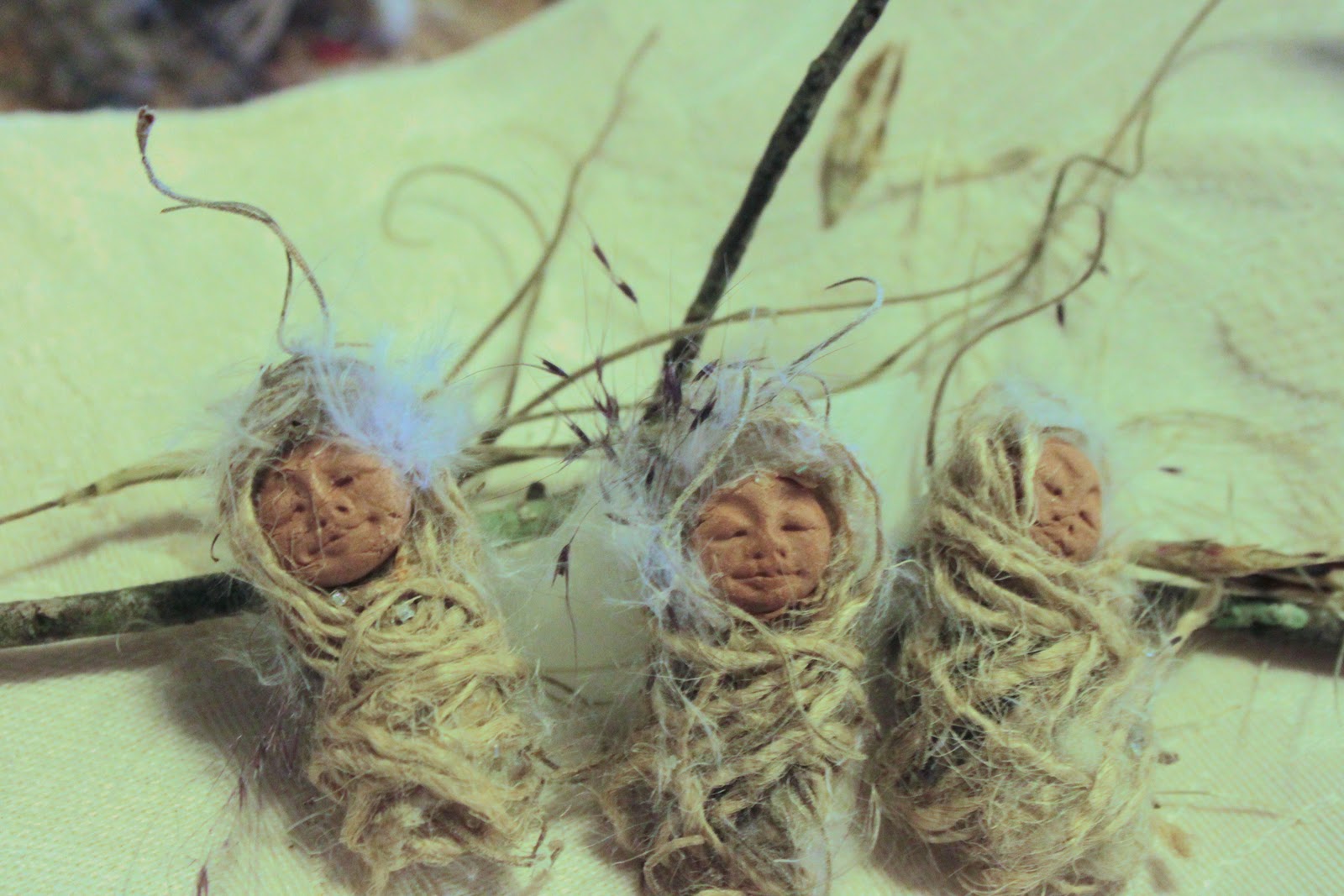
Now, I can start some other things that have been boiling inside. Like the crotchet mandala-dreamcatchers.  I was messing around with some materials last night and came up with these little Snow Bees. They are really tiny, about the size of the pinkie finger and half the length. Since I named them, they have grown little wings (feathers). I plan on hooking a few of them to colorfully adorned slight branches and placing them in vintage glass vases.
This weekend I am going to go looking for the vases at the thrift stores.

Until later.

Peace.
Brianne